Language

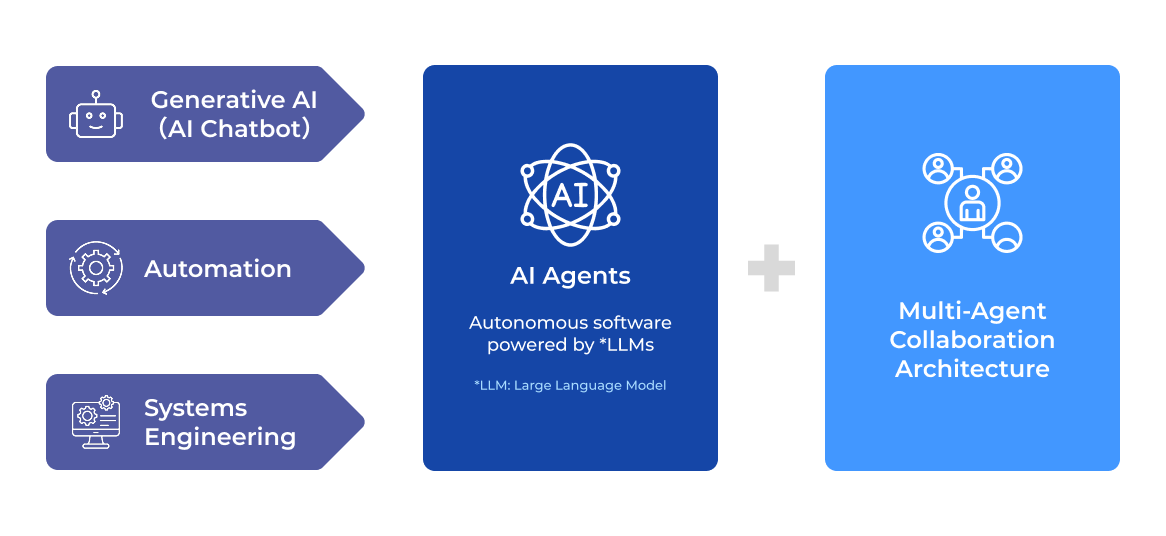
Orchestrate a higher level of intelligence with Multi-Agent System (MAS). MAS serves as the foundational architecture for Agentic AI, transforming static workflows into a collaborative network of autonomous experts. Move beyond task-specific assistance to a self-evolving ecosystem that thinks, acts, and scales with your business.
Move from simple prompts to autonomous E2E task completion

Seamlessly add or modify specialized agents as business needs shift
Eliminate single points of failure with decentralized, adaptive agent nodes

This diagram highlights a Hierarchical MAS architecture, where a Supervisor Agent orchestrates specialized Task Agents to ensure governed, high-quality responses—ideal for risk-sensitive environments. It is one of several configuration models that can be applied based on your specific operational goals.
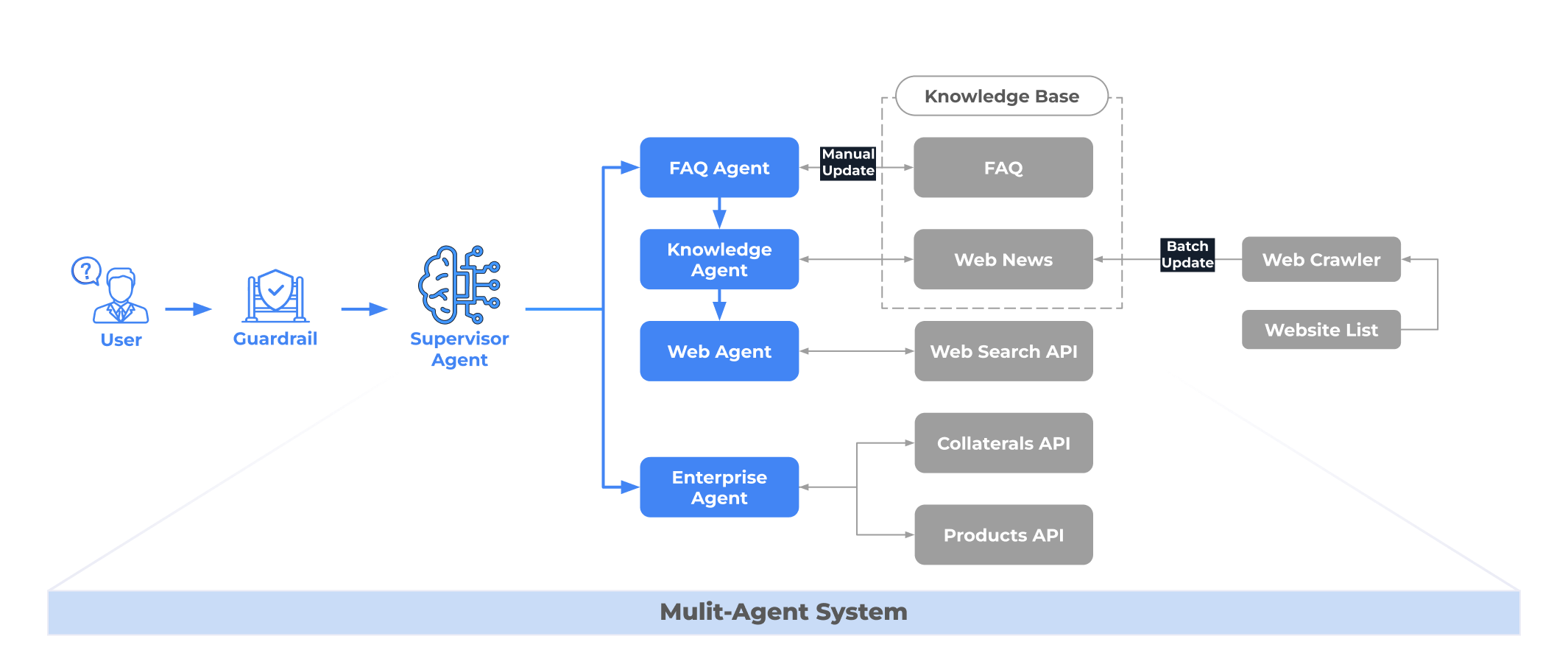
MAS architectures are not "one-size-fits-all" and must be selected based on your specific use case and functional requirements. Whether you require the structured governance of a Hierarchical model or the decentralized resilience of a Peer-to-Peer (P2P) system, we deploy the configuration that best aligns with your existing business logic.


A Multi-Agent System (MAS) is an AI architecture where multiple specialized AI agents work together to accomplish a shared objective. Rather than relying on a single AI agent to handle every task, each agent is assigned specific responsibilities and collaborates with others to solve complex problems more efficiently.
Agentic AI refers to AI systems that can autonomously plan, reason, and take actions to achieve defined goals. An AI Agent is an individual component that performs a specific task, while Agentic AI often involves multiple agents working together as part of a larger system to execute more complex workflows.
The right Multi-Agent System (MAS) architecture depends on your business objectives, workflow complexity, governance requirements, and operational needs. Common architectures include hybrid, federated, hierarchical, decentralized, and workflow-oriented models. We assess your requirements and deploy the architecture that best aligns with your existing business logic and operational goals.
Multi-Agent Systems are particularly valuable for organizations with complex workflows, large volumes of information, or business processes that span multiple teams and systems. Common use cases include customer service automation, knowledge management, workflow orchestration, financial operations, supply chain management, and enterprise decision support.
Effective collaboration requires clear agent roles, orchestration mechanisms, governance controls, and defined workflows. By assigning specific responsibilities to individual agents and coordinating their interactions through a structured framework, organizations can improve efficiency while maintaining visibility and control over AI-driven processes.
Unlike architectures that depend on a single AI component, Multi-Agent Systems distribute responsibilities across multiple agents. This approach improves resilience by reducing reliance on any one agent and enabling workflows to continue operating even if individual components encounter issues or require maintenance.
Unlike architectures that depend on a single AI component, Multi-Agent Systems distribute responsibilities across multiple agents. This approach improves resilience by reducing reliance on any one agent and enabling workflows to continue operating even if individual components encounter issues or require maintenance.